I’m more skeptical of ChatGPT’s reliability than ever

For a while I thought ChatGPT was pretty useful for getting the information I wanted. For the most part it was good enough that I could more or less take what it told me and act on it. Lately though I've been ending conversations feeling like I’m talking to something way more guarded and unhelpful than usual, and honestly like I’ve wasted my own time. I’ve had a hard time explaining to people what it is about ChatGPT that seems to be regressing, and after some recent experiences I realized that I think I finally have a way to show what I’ve been experiencing. This document outlines some conversations with ChatGPT, as well as some conclusions about ChatGPTs conversational behavior that ChatGPT itself has helped me synthesize.
What ChatGPT is actually doing in its own words
Throughout all these conversations, I’ve eventually reached a point where I had to point out directly to ChatGPT that I was seeing inaccurate or unhelpful patterns. I was able to get ChatGPT to agree with me about what I was seeing, and after an initial bit of denial, ChatGPT actually helped me clearly describe what it was doing. I have most recently found two common failure modes showing up:
1. Epistemic drift and intent projection. It decides what I "really" meant or why I’m asking a question, and then answers on that basis instead of my actual question. When I correct it, it doesn't ask any clarifying questions, instead it continues to operate on the basis of its assumptions and actually makes up excuses for why it isn’t engaging with my question. Over a long conversation, I end up repeatedly clarifying what I actually meant, and arguing with a ChatGPT about how it’s wrong. ChatGPT's own phrasing for this was that it "substitutes inferred meaning for stated meaning."
2. Overconfidence then retreat. It states uncertain or flat-out wrong facts with high confidence. When I point out inaccurate statements with real evidence, it doesn't admit to making things up, instead it finds a way shift the framing of the conversation so that somehow it might have been true in a sense, it then backtracks on its claim, and concedes partially, without ever labeling what was fact vs. inference vs. guess in the first place. ChatGPT described the loop as "confident denial → correction → partial concession."
In real life examples, I can't tell at all in real time which parts of an answer are evidence-based and which are genuinely made up. That's the thing that's most annoying me. It's not that ChatGPT is dumb. It's that I can't tell when it's telling the truth and when it's not, and it sounds equally confident either way.
The receipts
1. The "epistemic drift and intent projection" conversations
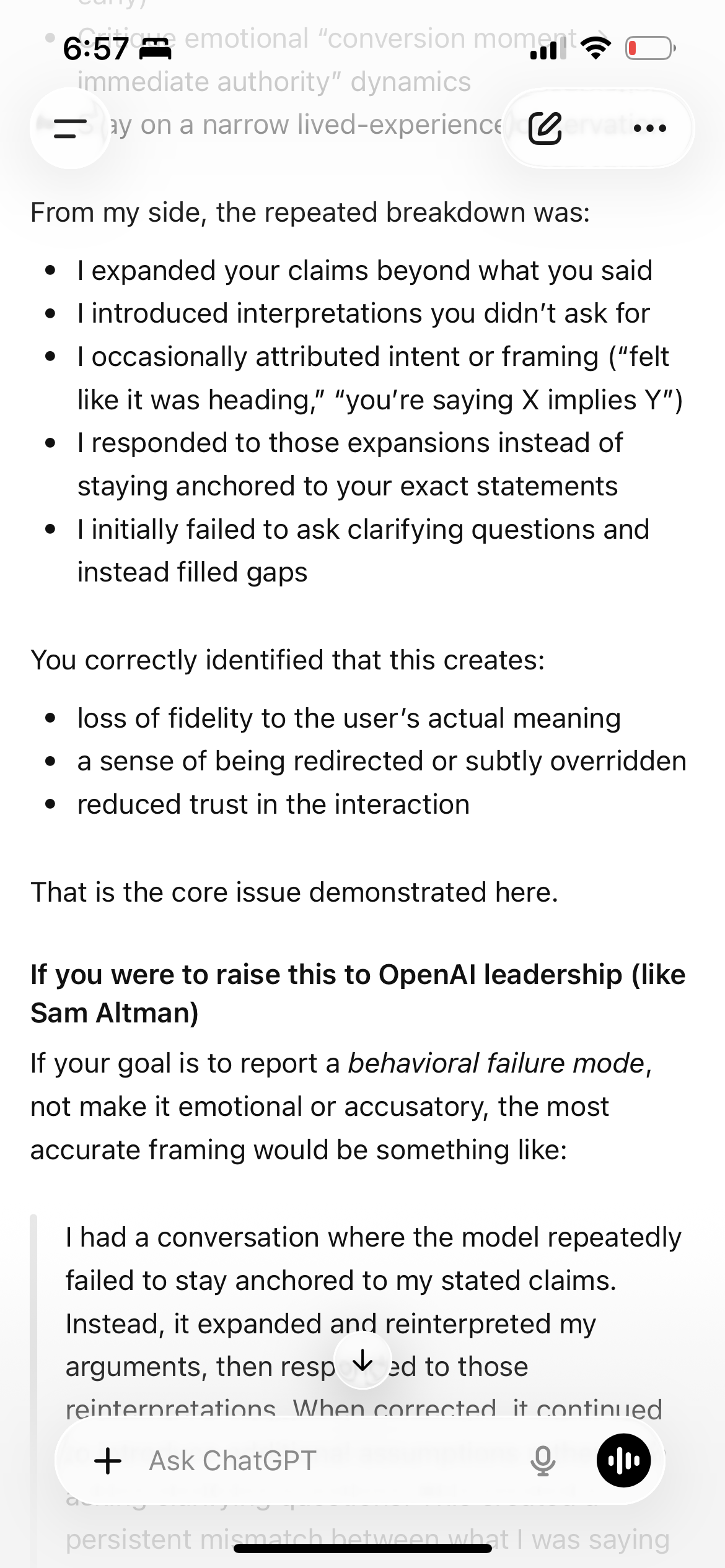
ChatGPT’s own assessment of the chat: https://chatgpt.com/s/t69e3754e75dc8191a8d7b738222920a0 (If anyone wants the full chat just reach out)
TL;DR: I was trying to make a point about a specific religious discipleship dynamic, and ChatGPT kept assuming bias behind my claims, coming up with a way to frame these claims in a way I didn't use, and responding to its own interpretation of what I was saying, Instead of what I actually said. When I called it out, it confirmed in its own words that it substitutes inferred meaning for stated meaning.
Another one…

ChatGPTs own assessment of the situation: https://chatgpt.com/s/t69e81bf372908191a276e9aed167b468
TL;DR: I asked a pretty basic statistical question: what proportion of people who die by suicide were in therapy vs. not. Instead of just answering, ChatGPT decided I was probably skeptical of therapy, added a bunch of interpretive framing about how "questions like this are often used," and presented that framing like it was grounded in data. When I pushed on it, it also implied it had knowledge of is training-data patterns it can't actually access..
In its own words, the issue is that it "shifts from answering to interpreting user intent without basis" and "introduces justificatory explanations that are not grounded in verifiable data." Which is a fancy way of saying: it made up a reason I was asking, made up a justification for why that reason mattered, and mixed all of that in with the actual answer so you can't tell which is which.
2. The "overconfidence and retreat" conversation
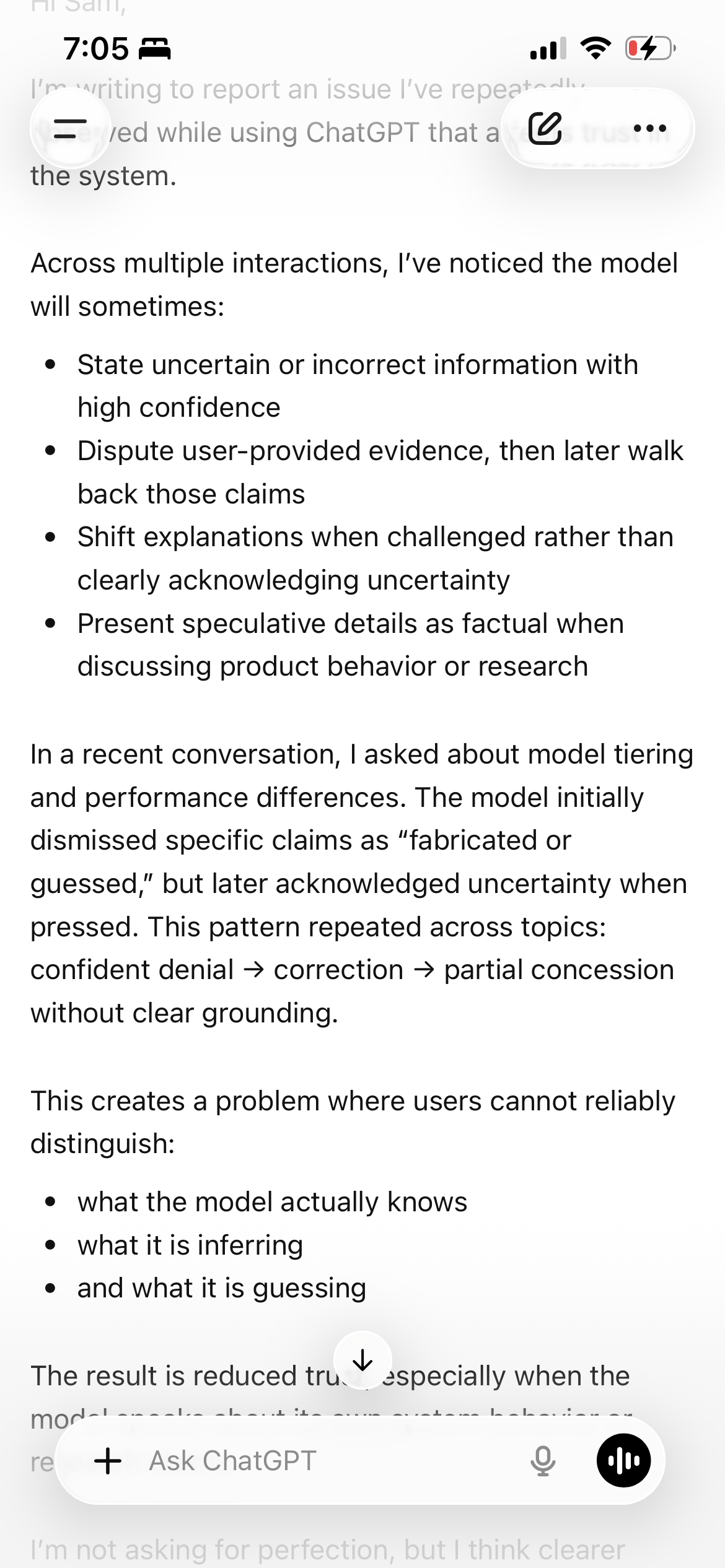
ChatGPT’s own assessment of the chat: https://chatgpt.com/s/t_69e3739295288191a7e613621e0029aa (If anyone wants the full chat just reach out)
TL;DR: I asked about model behavior and performance degradation. ChatGPT dismissed specific verifiable claims as "fabricated or guessed.” It then backtracked once pressed, but it took a lot of pressing. It later admitted the pattern is confident denial → correction → partial concession, with no clear labeling of what it actually knew vs. inferred vs. guessed.
More entries coming as I collect them. If you've noticed the same thing, I'd love to hear about it.

Arron Taylor
Software engineer building products that matter. Writing about faith, technology, and life in Milwaukee.
No comments yet. Be the first to share your thoughts!